What is Adaptive Software Development (ASD)?
Adaptive Software Development (ASD) is a modern software project management approach designed for today’s fast-moving industries. Unlike traditional methods, it belongs to the family of agile software development frameworks that prioritize flexibility, collaboration, and speed. Instead of sticking to fixed rules, the adaptive software development methodology encourages teams to adjust as projects evolve.
This approach fits perfectly for complex and dynamic projects where requirements shift often. With ASD, development is more of a continuous journey than a rigid roadmap. By focusing on adaptability, teamwork, and learning, ASD helps organizations deliver value faster while boosting customer satisfaction in software projects.
Why businesses in the USA choose ASD
Companies in the USA operate in highly competitive and innovative markets. They need methods that deliver quick results while staying adaptable. ASD offers exactly this advantage. Many U.S. startups and enterprises use it to remain ahead of competitors because it supports flexible software development and keeps products aligned with user expectations.
History and Evolution of ASD
The roots of ASD go back to the mid-1990s. Jim Highsmith and Sam Bayer introduced it as an extension of rapid application development (RAD). They believed that traditional methods lacked adaptability and did not handle uncertainty well. Their work led to the creation of a more iterative software development process.
In 1998, Jim Highsmith published the book Adaptive Software Development: A Collaborative Approach to Managing Complex Systems. This book became the foundation of the method. Later, Highsmith became one of the authors of the Agile Manifesto, which changed how teams think about software forever.
Milestones in ASD development
Over the years, ASD has grown alongside other agile software development processes. By the early 2000s, it was being used by organizations worldwide to handle complex and dynamic projects. Today, it remains relevant, especially in the United States, where companies demand adaptability in software project management.
Key Characteristics of Adaptive Software Development
ASD is built on strong principles that make it stand out. It thrives on adaptability and encourages self-organizing teams in agile environments. Teams make decisions together instead of following strict instructions. This culture of collaborative software development builds trust and boosts creativity.
Another defining trait of ASD is its commitment to continuous learning in agile. Each step in the project provides feedback that helps improve the process and product. ASD also includes risk management in software development, which reduces failures by addressing problems early.
Core principles of ASD
The guiding values of ASD can be seen in its everyday practices. It supports incremental software delivery, where progress comes in small but steady releases. It promotes adaptive planning vs detailed planning, meaning plans can shift as needs change. At the heart of it lies team empowerment in agile, giving people ownership and responsibility. Above all, it integrates software testing and debugging throughout the work, ensuring quality from start to finish.
Phases of the ASD Process
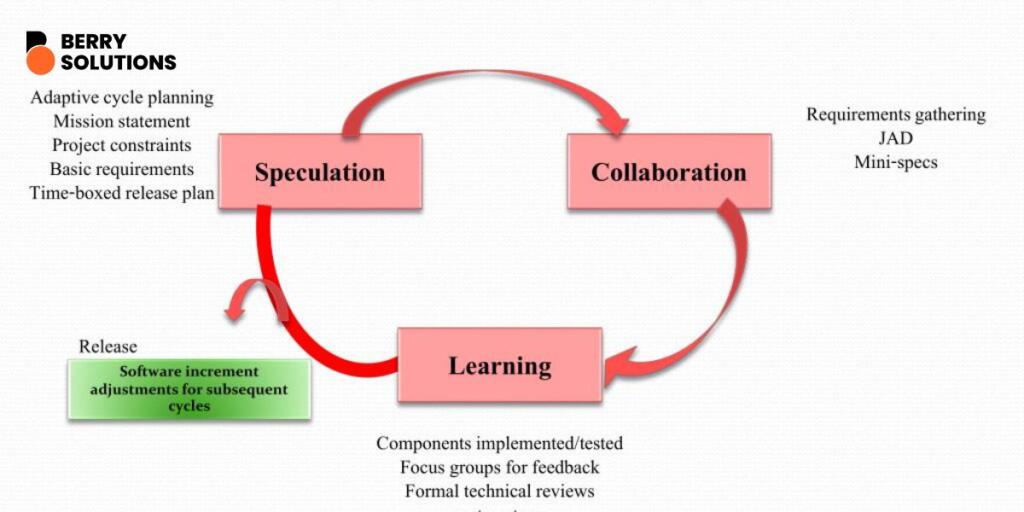
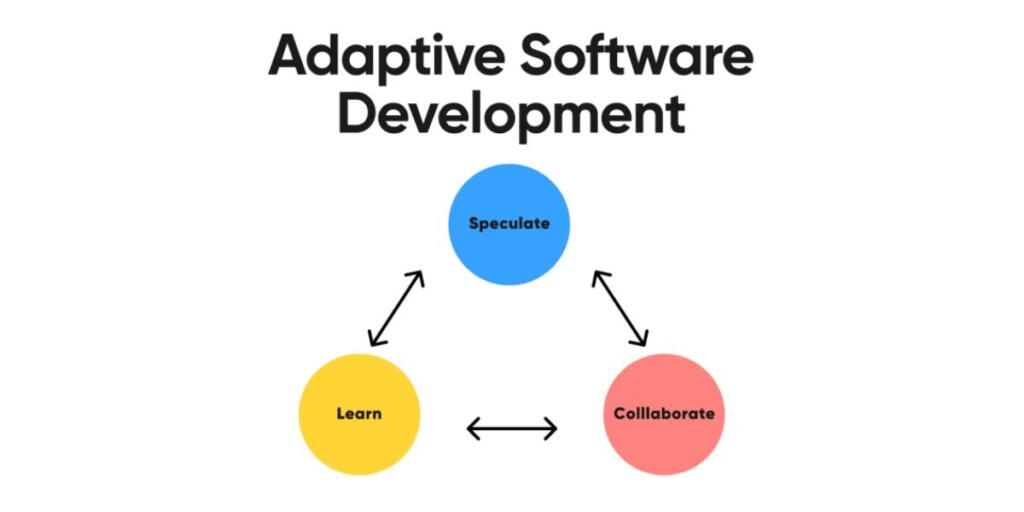
The project life cycle phases in ASD are unique. They are known as the speculation, collaboration, and learning phases. Unlike traditional models, these stages are not rigid. They evolve with the project, allowing room for change and growth.
Speculation begins with the project initiation phase. Here, teams discuss project requirements and user needs but avoid locking themselves into rigid structures. Collaboration is the heart of the process, where teamwork, trust, and creativity drive results. Finally, the learning phase closes the loop. Teams use project postmortem reviews, technical reviews in software projects, and feedback from users to improve.
Tools and practices for each phase
ASD also utilizes continuous testing, integration, and feedback tools. U.S. teams often adopt daily standups, focus groups, and feedback-driven development to strengthen collaboration. These steps keep projects aligned with reality, ensuring adaptability in changing environments.
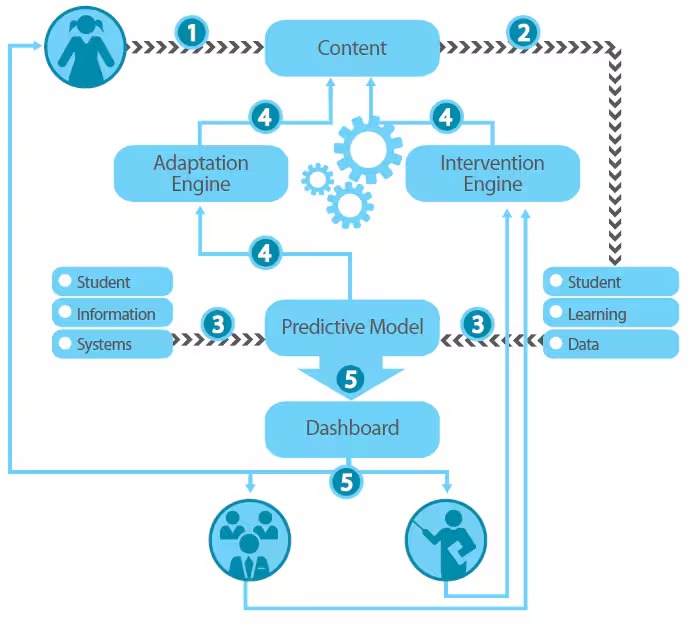
This diagram illustrates how adaptive software leverages predictive models to deliver personalized and efficient solutions. The process begins with content creation and student learning data, which feed into the system. Using a predictive model, the software analyzes information from student information systems to identify needs and opportunities. The adaptation engine and intervention engine then work together to adjust content and learning strategies in real time. All results are presented on a dashboard, providing actionable insights for both educators and learners. By continuously adapting through this cycle, adaptive software ensures a tailored, data-driven experience that enhances performance and engagement.
Explore more of our innovative projects in our Portfolio to see how we bring such solutions to life.
Advantages of Adaptive Software Development
ASD comes with several strengths. It is highly suited for complex and dynamic projects, where change is frequent. The software development lifecycle (SDLC) under ASD is shorter and more flexible. Products reach the market faster because of incremental software delivery.
Another advantage is its focus on people. By promoting team empowerment in agile, it keeps members motivated and engaged. This builds stronger trust, better solutions, and higher morale. For customers, ASD provides visible progress and ensures continuous value.
Why ASD works well in U.S. markets
The U.S. market is fast-paced and highly innovative. Customers expect results quickly. ASD’s emphasis on customer satisfaction in software projects aligns perfectly with these demands. Its adaptability helps U.S. tech firms, especially startups, to thrive and keep up with evolving market trends. For businesses looking to implement adaptive and flexible solutions, you can explore our Custom Software Development Services.
Disadvantages and Challenges of ASD
While ASD has strong benefits, it also faces challenges. One major issue is skill level. Successful ASD requires a deep understanding of agile principles and values and experience with software project management. Teams without these skills often struggle, and you can read more about agile software development practices here.
Another drawback is the risk of scope creep. Because of adaptive planning vs detailed planning, requirements can often change. Without careful control, this can lead to delays. Teams also depend heavily on customers for input, and if customers are not available, projects may slow down.
Common mistakes teams make with ASD
Some teams rush into ASD without proper preparation. They may underestimate the importance of tools like software measurement & metrics. Others neglect communication or fail to establish trust. These mistakes reduce the value of ASD and make adaptability in changing environments harder to achieve.
Comparing ASD with Scrum, Kanban, and Other Agile Methods
It is helpful to compare ASD with other models. Waterfall follows a linear path, while ASD offers flexible software development. Scrum focuses on sprints, while ASD relies on continuous feedback and feedback-driven development. Kanban prioritizes flow, but ASD emphasizes continuous learning in agile and adaptability.
Here is a table to show the differences clearly:
| Aspect | ASD | Waterfall | Scrum | Kanban |
| Approach | Adaptive and iterative | Sequential | Iterative and sprint-based | Flow-based |
| Planning | Adaptive planning vs detailed planning | Detailed upfront | Sprint planning | Continuous |
| Customer Role | Continuous | Early only | Active in reviews | Continuous |
| Risk Handling | Ongoing | Early phase | Continuous | Continuous |
| Best Suited For | Complex and dynamic projects | Stable projects | Quick delivery | Continuous delivery |
Best scenarios for each method
ASD is best when projects face high uncertainty. Scrum works when timelines are strict and teams are experienced. Kanban helps when there is a steady flow of tasks. Waterfall still fits projects with very stable requirements.
For a deeper understanding of when to use ASD and other agile methods, you can visit Agile Alliance’s guide on agile frameworks.
When Should You Use Adaptive Software Development?
ASD is best suited for complex and dynamic projects that need constant evolution. It works well when user expectations change, or when technology shifts rapidly. Companies that prioritize customer satisfaction in software projects find ASD a natural fit.
However, not every organization benefits from ASD. If your environment demands fixed costs, strict deadlines, and rigid control, ASD may not be ideal. Businesses that lack strong teamwork or customer involvement may find other agile software development frameworks more suitable.
Who should avoid ASD?
Organizations that depend on strict contracts, heavy documentation, or rigid reporting structures may struggle. ASD’s reliance on self-organizing teams in agile does not align well with centralized decision-making. Such teams should consider Scrum or Waterfall instead.
Conclusion: Is ASD Right for Your Team?
Adaptive Software Development methodology is powerful for projects that demand flexibility. It combines incremental software delivery, collaborative software development, and feedback-driven development into a process that thrives in change.
For U.S. businesses facing uncertainty, ASD can provide speed, adaptability, and value. If your team embraces team empowerment in agile and understands the software development lifecycle (SDLC), ASD can be the key to delivering products that stay relevant in today’s fast-moving world. To discuss how ASD can work for your projects, contact us today.
FAQs:
What is the meaning of adaptive software?
Adaptive software is a type of software designed to adjust automatically to changing conditions, user needs, or system environments. It focuses on flexibility, allowing the software to evolve without requiring major redesigns. In Adaptive Software Development (ASD), this adaptability is central to meeting dynamic project requirements.
What is adaptability in software development?
Adaptability in software development is the ability of a system or process to respond efficiently to changing requirements, environments, or user needs. It allows developers to modify functionality, improve performance, or fix issues quickly, making the software more reliable and suitable for complex and dynamic projects.
What are the three phases of adaptive software development?
The three phases of ASD are Speculation, Collaboration, and Learning. Speculation involves planning with flexibility. Collaboration emphasizes teamwork, trust, and communication. Learning focuses on gathering feedback, conducting project postmortem reviews, and improving both the process and the product continuously.
What is an example of adaptive software maintenance?
An example of adaptive software maintenance is updating a mobile app to support new operating system versions without changing its core functionality. Another example is modifying an e-commerce platform to handle higher traffic during holiday seasons while maintaining customer satisfaction in software projects.
What is another name for adaptive?
Another name for adaptive is flexible or adjustable. In software terms, it can also be called evolutionary, highlighting its ability to respond to changes and continuously improve.
What is the purpose of adaptive technology?
The purpose of adaptive technology is to enhance user experience by adjusting to individual needs or environmental changes. In software, it ensures systems remain functional and efficient under changing conditions, supporting continuous learning in agile and improving overall performance.