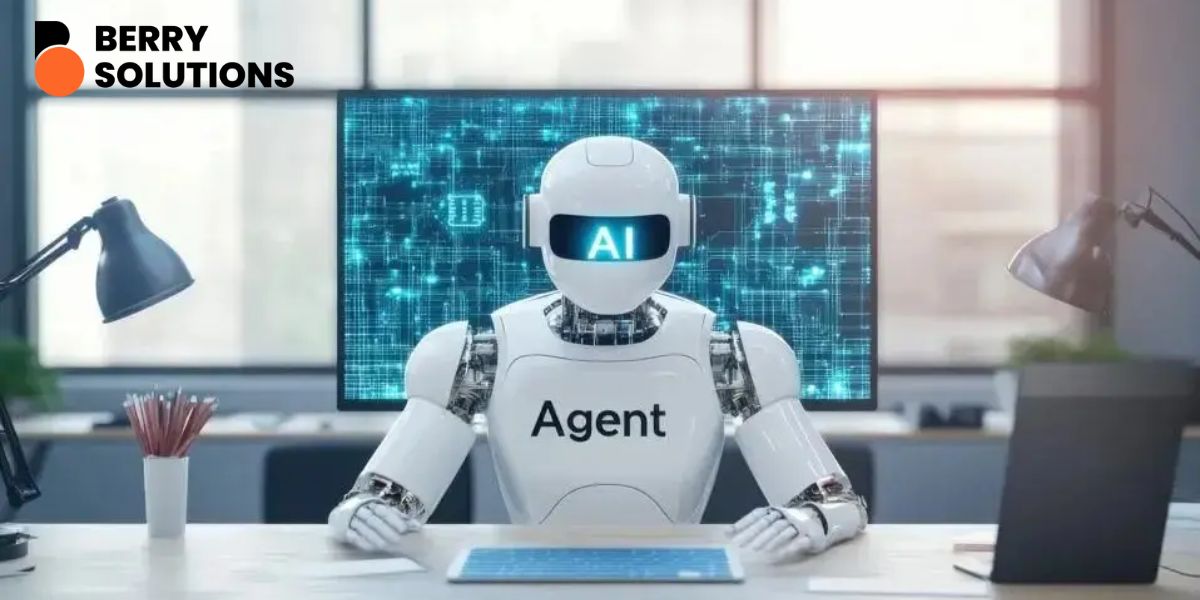
Artificial intelligence is no longer just a buzzword. Businesses across the USA are rapidly embracing AI agents to improve efficiency, enhance decision-making, and automate repetitive tasks. An AI agent is an autonomous agent that can understand goals, interact with tools, and take actions independently.
These systems use agentic AI principles and advanced LLM agents to perform tasks without constant human guidance. By integrating tool-calling AI and external tools integration, companies can achieve faster and smarter outcomes.
Modern organizations benefit from multiagent systems that collaborate to solve complex problems. Unlike traditional software, these autonomous systems can adapt to changing environments, refine their actions, and deliver personalized results. Their ability to perform task automation and workflow automation makes them a vital tool for businesses aiming to stay competitive in the digital era.

What Are AI Agents?
AI agents are software entities designed to perform tasks on their own by using autonomous decision-making and adaptive AI. They observe their environment, analyze data, and take actions based on agent memory and pre-programmed rules. Unlike simple AI chatbots, AI agents can interact with multiple tools, learn from feedback, and improve over time.
In the USA, companies use AI agents for a variety of applications, from customer service to financial analysis. These agents integrate LLM-based reasoning and external data retrieval to provide context-aware responses. The combination of human-in-the-loop feedback and iterative refinement allows these agents to become smarter with each interaction.
Key Features and Core Principles of AI Agents
The core of AI agents lies in their ability to perform autonomous decision-making and task decomposition. They use AI planning and reasoning to break complex goals into manageable subtasks. Features like agent memory, self-correction AI, and adaptive reasoning ensure the agent improves over time and aligns with user expectations.
Modern AI solutions, such as those offered in our AI Development Services, help businesses implement powerful agent-based systems with real value.
These systems also follow reasoning paradigms like the ReAct model and ReWOO framework to plan, act, and observe results iteratively. By employing chain-of-thought reasoning, AI agents can simulate human-like thought processes, making them more effective than nonagentic chatbots that only follow static scripts.
How AI Agents Work
These intelligent systems operate by sensing their environment, reasoning through information, and taking actions to achieve specific goals. They use tool usage prediction and external data retrieval to gather necessary inputs. Their knowledge base updating and memory-based learning help store previous decisions and refine future responses.
When receiving a new task, these autonomous agents perform workflow planning, agent collaboration, and action sequencing. This iterative process uses multiagent feedback to improve decision accuracy. Companies gain AI performance improvement and adaptive AI that can respond dynamically to changing conditions without constant human supervision.
Types of AI Agents
There are several types of AI agents, each serving different purposes. Simple reflex agents respond to immediate conditions without memory, while model-based agents maintain an internal world model to guide decisions. Goal-based agents plan actions to achieve specific outcomes, and utility-based agents evaluate the best actions using utility calculation. Learning agents continuously update their knowledge and adapt using iterative improvement.
Each type of agent is suitable for different business needs. For instance, goal-based agents are ideal for logistics and routing tasks, while learning agents can personalize customer recommendations in e-commerce. Companies can combine multiple types into multiagent systems to tackle complex operations efficiently.

AI Agents vs AI Assistants vs Chatbots
While AI chatbots handle simple conversations, AI agents go beyond by performing autonomous decision-making and task automation. Nonagentic chatbots cannot plan, store memory, or adapt, whereas AI agents can integrate external tools, learn from feedback, and provide personalized AI responses.
AI assistants often act as intermediaries, helping users with tasks like scheduling or reminders. In contrast, it can solve complex problems, coordinate with other agents, and improve over time through human-in-the-loop oversight and adaptive reasoning. The difference lies in agentic behavior versus reactive scripting.
Key Components of AI Agent Architecture
The architecture of an AI agent includes a knowledge base, memory, planning module, environment interface, and integration with external tools. Agent memory stores prior decisions, while the planning system guides navigation planning and task decomposition. Feedback mechanisms and multiagent feedback ensure continuous learning.
These components enable AI planning and reasoning, tool-calling AI, and performance optimization. For example, a customer support AI agent uses its internal world model to suggest solutions while monitoring feedback loops for iterative improvement. Proper design also addresses data privacy in AI and AI security risks to maintain trust.
Benefits of Using AI Agents
Using AI agents in business provides clear advantages. They enable task automation, reduce operational costs, and enhance decision-making AI capabilities. Companies gain workflow automation, adaptive AI, and AI performance improvement across multiple departments.
To support this growth, many organizations also explore advanced digital solutions offered through our IT services, helping them integrate AI more effectively into their systems
In addition, it provides personalized AI responses to users, improves context-aware responses, and allow companies to scale efficiently. Businesses in the USA, especially in finance and healthcare, see significant ROI by implementing these autonomous agents for repetitive or complex processes.
Real-World Examples and Use Cases
In retail, learning agents track user behavior to provide tailored product recommendations, improving conversion rates. Healthcare systems use AI agents to schedule treatments, manage patient data, and predict potential emergencies. In logistics, goal-based agents optimize supply chains and routing, using tool-calling AI and external data retrieval for real-time updates.
Several US companies, including Amazon and Microsoft, integrate multiagent systems to combine AI chatbots with autonomous agents, providing seamless customer support. These real-world applications highlight the transformative power of AI agents in modern enterprises, and platforms like IBM AI Solutions further demonstrate how advanced agentic systems are reshaping business automation.
Challenges, Risks, and Limitations
Despite their benefits, intelligent automation systems face several challenges. Computational complexity and expensive infrastructure can limit adoption. Multi-system dependencies may also create infinite feedback loops, leading to unexpected errors. Additionally, poor management of data privacy in AI and growing AI security risks can put sensitive business information at risk.
Organizations must implement strong risk-mitigation strategies and maintain proper AI governance. Human supervision remains essential in high-stakes environments to ensure that autonomous behavior aligns with company goals. With careful deployment and oversight, businesses can prevent unintended outcomes and maintain trust in these advanced automation solutions.
Best Practices for Implementing AI Agents
Businesses should maintain activity logs to track AI planning and reasoning, enabling transparency. Ensuring human supervision during critical actions and integrating interruptibility prevents infinite feedback loops. Unique identifiers for agents help track responsibility and enhance AI governance.
Continuous iterative refinement and feedback loops improve adaptive AI performance. Combining multiagent feedback, tool usage prediction, and knowledge base updating ensures that AI agents provide consistent, accurate, and secure solutions. Following these best practices allows US businesses to implement AI agents effectively and safely.
Table Example: Comparison of AI Agents vs AI Assistants vs Chatbots
| Feature | AI Agent | AI Assistant | Chatbot |
|---|---|---|---|
| Autonomy | High | Medium | Low |
| Task Complexity | High | Medium | Low |
| Memory | Yes (agent memory) | Limited | No |
| Feedback Learning | Yes (multiagent feedback) | Limited | No |
| Integration with External Tools | Yes (tool-calling AI) | Limited | No |
FAQs:
What does an AI agent do?
An intelligent system autonomously performs tasks, makes decisions, and interacts with tools or data to achieve specific goals. It can adapt, learn, and optimize workflows without constant human guidance.
Is ChatGPT an AI agent?
ChatGPT is mainly an AI language model, not a fully autonomous system, because it lacks independent decision-making and tool integration. It can, however, be part of a larger agent system when combined with external tools.
Who are the big 4 AI agents?
The “Big 4” often include Google’s Bard, Microsoft Copilot, Anthropic’s Claude, and OpenAI’s GPT-based systems. These platforms combine advanced reasoning with tool integration to perform complex tasks.
What are the 5 types of agents in AI?
The five main types are simple reflex, model-based, goal-based, utility-based, and learning systems. Each type differs in memory, reasoning, and decision-making abilities.